Whoop is Hiring 600 People while Everyone Else is Cutting | Part 2
Here’s Why Most Businesses May Be Wrong About AI
The headlines are exhausting. “AI will replace 40 million jobs by 2030.”
Every conversation about artificial intelligence seems to start and end with a negative headcount. Everyone is just trying to optimize how efficiently they can slice up a fixed pie (or so they say…)[3].
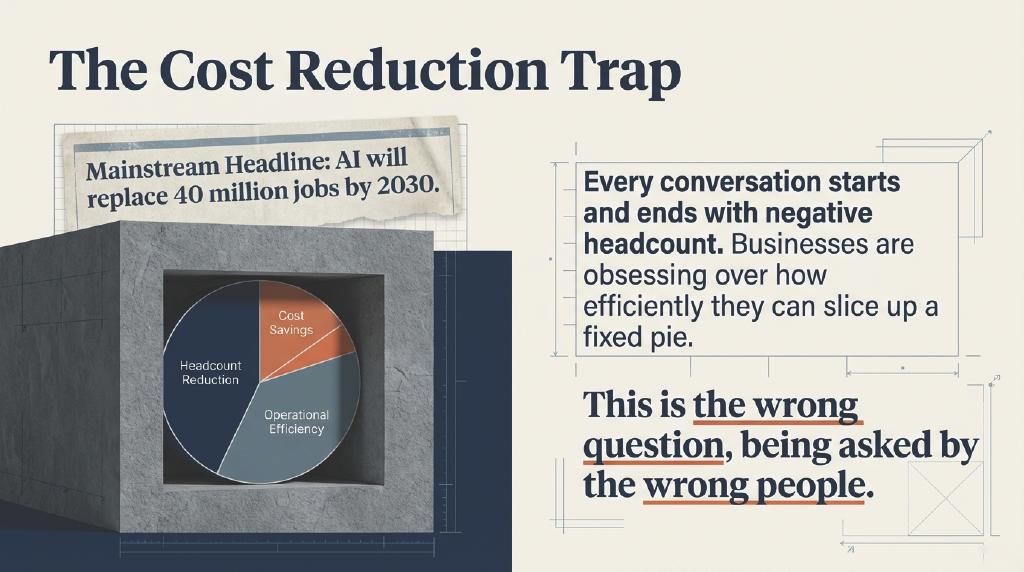
But IMHO, this is the wrong question, being asked by the wrong people.
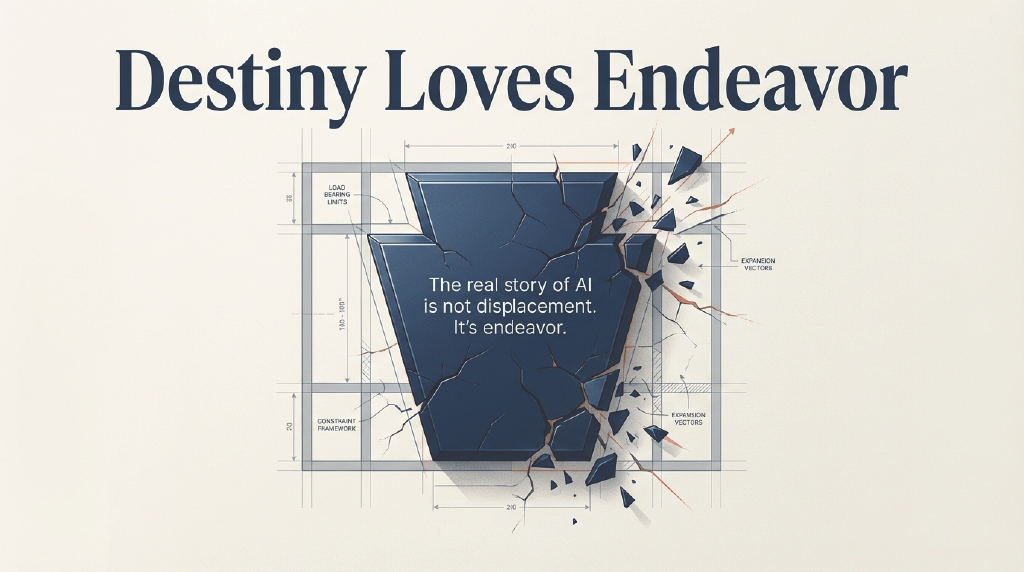
I’ve experienced the history of technology firsthand. It shows us that this “cost reduction frame” is a huge trap. The real story of AI is not displacement. It’s endeavor. And destiny loves endeavor!
The Power of Jevons Paradox
I’m about to suggest something. In March 2026, Whoop (the performance wearable company) announced they are hiring over 600 people[1]. They are nearly doubling their workforce.
To understand why Whoop is right and the “cutters” are wrong, you need to understand Jevons Paradox[2]. It describes how, when a resource becomes more efficient, we don’t use less of it. We consume MORE of it. Why? Because cheaper resources make brand-new applications viable.
AI represents the most significant efficiency boost in the history of work. It drastically reduces the costs of insight, judgment, and creativity. Technical execution has become a commodity. When the cost of ‘doing’ drops to zero, the value of ‘knowing what to do’ becomes everything.
That last example might scare you, excite you, or maybe both.
Here’s why this matters. In May 2024, Klarna announced its legal team was using ChatGPT to draft contracts[5]. A one-hour task became ten minutes. Multiply that across every knowledge worker in the world. The math is brutal. When "thinking" becomes as cheap as electricity, traditional business models don't just adjust: they break.
This pattern always wins. Infrastructure comes early, disrupts the old world, and then waits for the new world to catch up. I wrote this article to further emphasize the point. The future is for people. I’ll explain why here in Part 2.
Six Unlocks: Shifting from Scarcity to Ambition
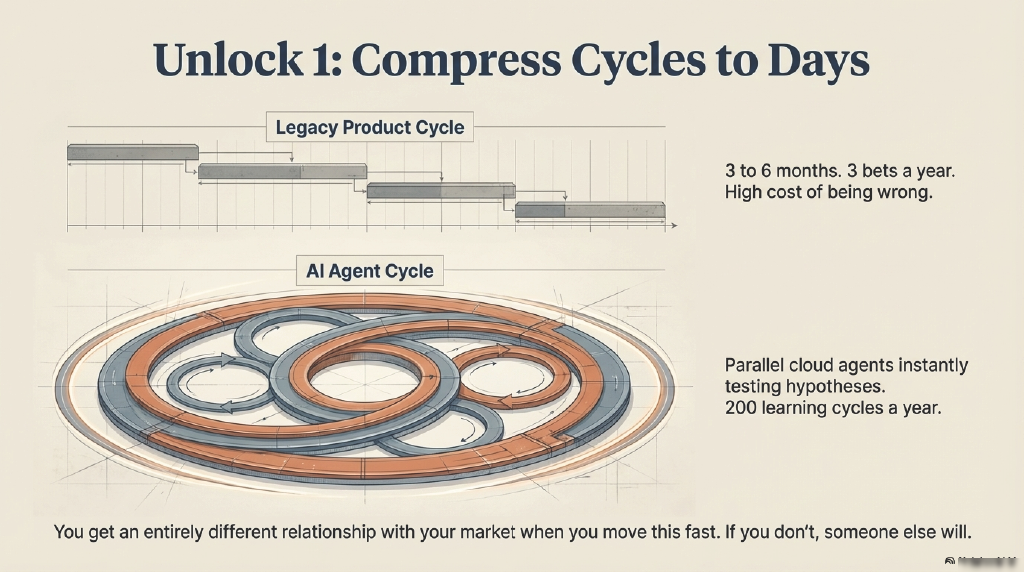
1. Go Fast. Your Strategy Depends on it.
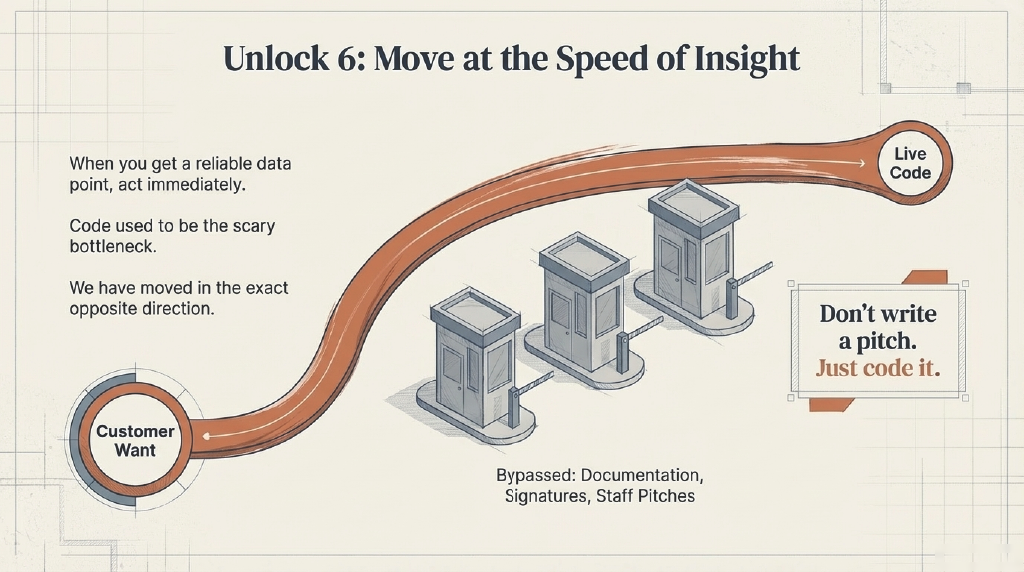
Compress cycles to days. Code used to be the scary bottleneck, but we have since moved in the exact opposite
direction. Technical debt is still real, but technical delay is now a choice. If you can build in a
week what used to take a quarter, your strategy can be iterative rather than speculative.
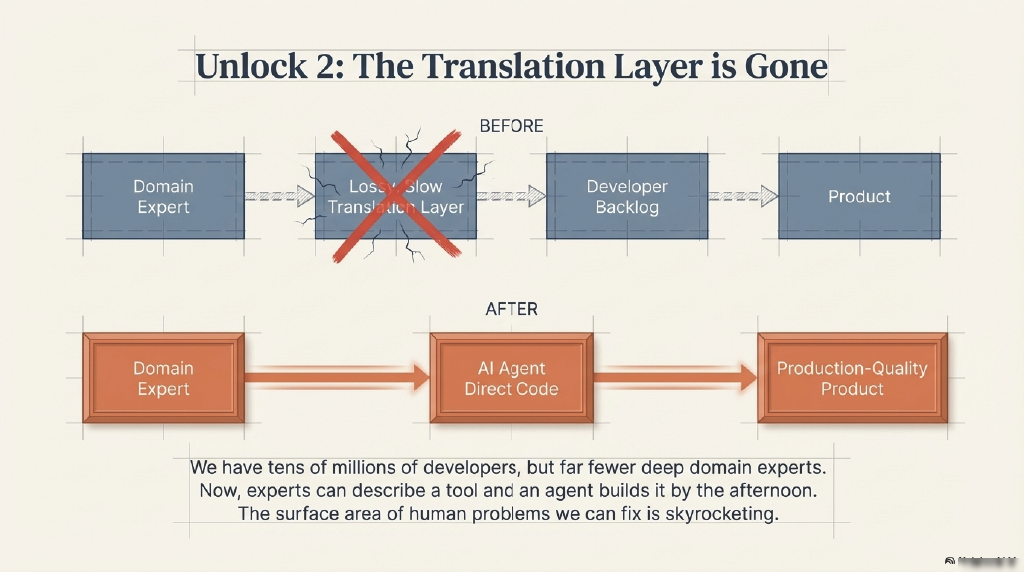
2. The Translation Layer is Gone.
Moving from executive intent to agentic workflow. We no longer need armies of people to "translate" a
business goal into a technical spec, then into a project plan, then into code. The AI can bridge that gap
directly. This removes the middle management overhead that kills most ambitious projects.
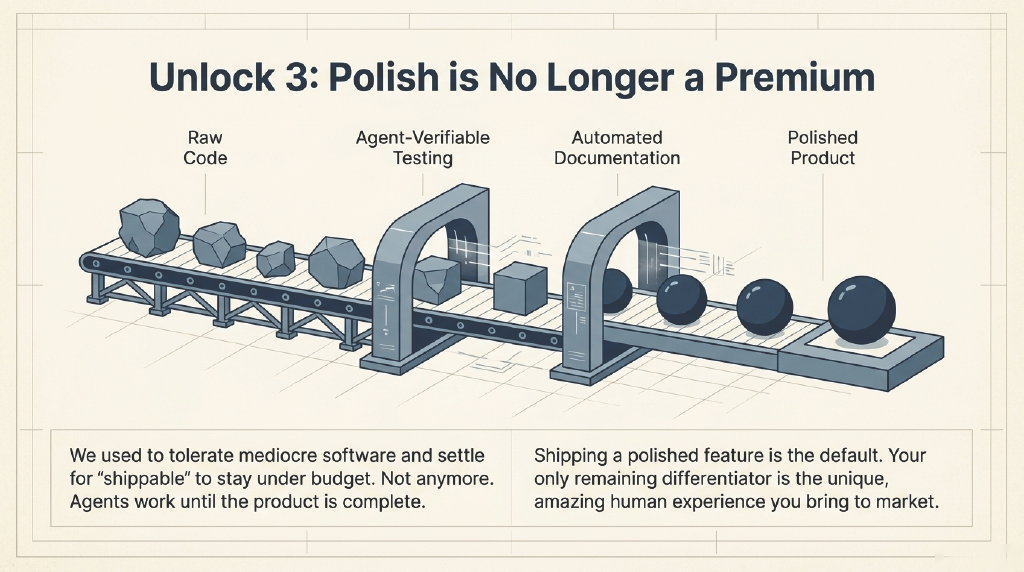
3. Software Quality is No Longer a Premium Feature.
Polish and testing are no longer bottlenecks. Settling for "shippable" is a relic of the past. When agents
can write tests, document code, and refactor for performance in seconds, every piece of software should be
high-fidelity. Quality is now the baseline, not the differentiator.
4. Every Employee is now a Manager of Agents.
The role of the individual contributor has changed forever[4].
You are no longer just writing lines of code or drafting reports; you are orchestrating a fleet of
specialized agents to do those things for you. This 10x leverage means we need fewer 'doers' and more
'architects'.
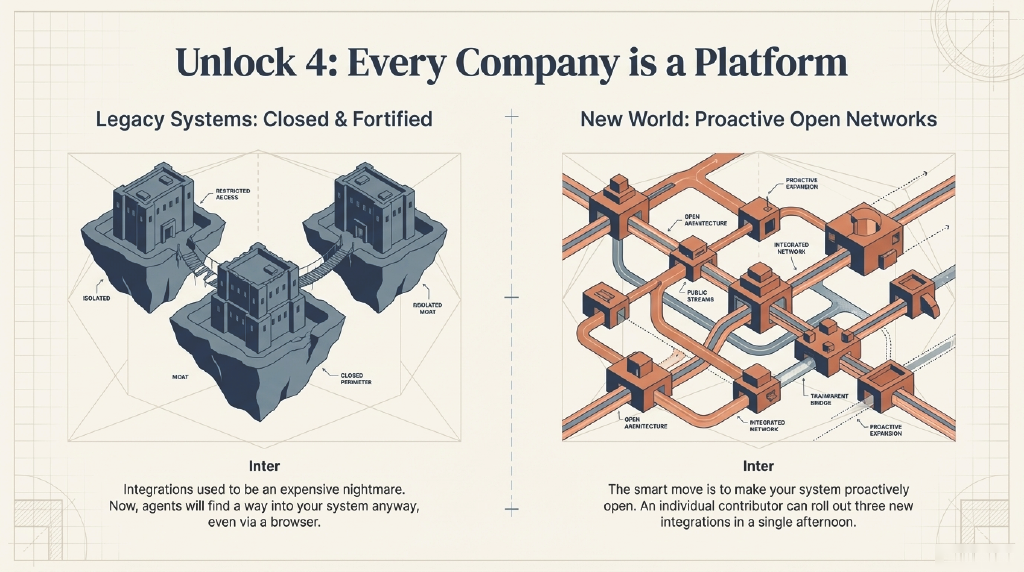
5. Every Company is Now a Platform.
In an AI native world, your value isn't your internal process; it's your data and your interfaces. By
building your company as a platform that agents can interact with, you enable a level of scaling that was
physically impossible with human centric workflows.
6. Destiny Loves Endeavor.
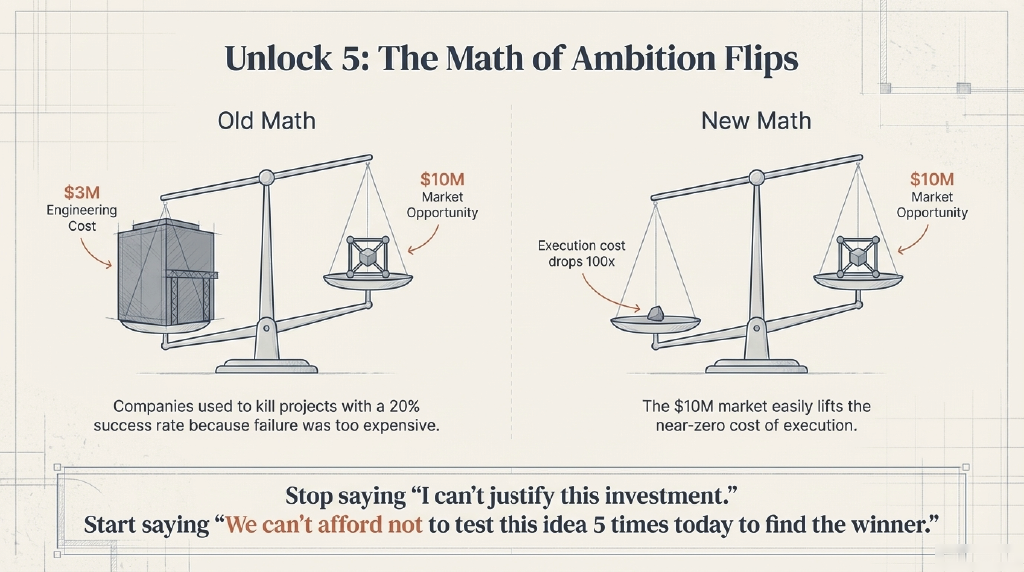
Stop saying “I can’t justify this investment” and start saying “we can’t afford not to test this idea.” The
cost of failure has collapsed, which means the cost of inaction has skyrocketed. Ambition is now the only
rational response to the AI era.
A Generated World or a Building World?
Here’s the hard truth. NONE of these six unlocks are speculative. They don’t require a tech breakthrough. They are all right here in front of you if you wish to take them.
The question isn't whether AI will replace you. The question is whether you will choose to be a 'cutter' (trying to survive by shrinking) or a 'builder' (choosing to expand into the new possibilities that AI makes affordable).
Whoop chose to build. They chose expansion. They chose endeavor. And in the AI era, there has never been more to build.
Frequently Asked Questions
What is the “Jevons Paradox,” and why does it matter for AI?
Jevons Paradox is the old idea that when something gets cheaper and easier to use, people usually do not use less of it. They use a lot more. That is the part many people miss.
That matters for AI because AI is making execution cheaper. Writing, coding, analysis, testing, research, design work, all of it is getting faster and easier to produce. So the real question is not whether companies will use less human effort. The real question is what happens when businesses can suddenly afford to try far more ideas than they could before.
That is the shift. We are not heading into a world with less ambition. We are heading into a world where ambition gets cheaper to act on. That is a very different thing.
Why is Whoop hiring 600 people while other tech companies are laying people off?
Because they may be looking at the same technology through a completely different lens.
A lot of companies are still treating AI like a cost cutting tool. Trim the team. reduce payroll. squeeze a little more output from fewer people. That is the scarcity mindset running the show.
Whoop’s move suggests a different bet. If AI lowers the cost of execution, then the winning move may not be to shrink. It may be to build faster, test more ideas, and put more capable people into motion while everyone else is busy protecting the old model.
That is what makes the hiring number so interesting. It is not just a staffing decision. It looks more like a statement about what kind of future they think is coming.
How does AI change the role of a typical employee?
For a lot of people, the job starts shifting away from doing every piece manually and more toward directing, shaping, judging, and refining.
That does not make humans less important. In many cases, it does the opposite. When the cost of doing drops, the value of knowing what should be done goes up. The bottleneck starts moving away from raw execution and back toward judgment, taste, domain knowledge, and vision.
Put simply, the future worker is not just a pair of hands on a keyboard. They are the person deciding what gets built, why it matters, and whether the result is actually any good.
What are the “Six Unlocks” for an AI native business?
They are six mindset shifts in the article that all point to the same bigger idea: AI is not just a way to save money. It is a way to remove the friction that kept good ideas stuck in meetings, backlogs, and technical delays.
• Move faster because speed now changes strategy
• Let domain experts get closer to execution
• Stop treating good software quality like some expensive luxury
• Build like a platform, not a closed box
• Go after ideas that used to look too small or too risky
• Act on insight while it is still fresh instead of burying it in process
That is really the heart of it. The article is arguing for a move from hesitation to action. From protecting the old pie to baking more pies.
Is the cost of inaction now higher than the cost of failure?
Yes, significantly. In the old model, where product development cycles took months and cost millions, a single 'bad bet' could paralyze a company's budget for an entire quarter. That reality trained an entire generation of leadership to prioritize risk avoidance over action.
But AI has rewritten the math of ambition. When the time and cost of execution collapse by orders of magnitude, the primary threat is no longer a failed experiment: it’s the missed opportunity to learn. In this new world, you aren't killed by the tests you fail; you are killed by the twenty chances you never took while your competitors were busy evolving.
Standing still has become the most expensive move on the board.
Research and References
"Start with a thesis, research all current articles on the subject, then write from source."
- [1] Whoop Press Center: WHOOP Announces 2026 Hiring Surge, Adding More Than 600 Roles
- [2] Wikipedia: Jevons Paradox
- [3] Salesforce Ben: Marc Benioff Dismisses AI Layoff Fears – But What Do the Numbers Say?
- [4] HackerRank: The Productivity Paradox of AI: Why Smarter Tools Are Creating More Developers, Not Fewer
- [5] Klarna International: 90% of Klarna Staff Are Using AI Daily—Game Changer for Productivity
- [6] Menlo Ventures: 2025: The State of Consumer AI
- Jim Walker: We've Built This Before | Part 1
- George Hoyem: AI Jobs and the Jevons Paradox: Why Efficiency Amplifies Human Relevance
- Built In Boston: WHOOP Commences Push to Create 600 New Jobs
- The Financial Express: AI Taking Jobs? Whoop CEO Will Ahmed Says Companies Are Using AI as a Convenient Excuse for Layoffs
- Eficode: Atlassian Team '25 Barcelona: AI Becomes the Key to Competitive Advantage
- Pulse 2: Redrob: $10 Million Raised To Scale Global AI Access
- The 5K Runner: Whoop IPO: Massive 600-Person Hiring Drive Signals Public Listing
- Wikipedia: Jevons Paradox
- Oxera: Ctrl+Alt+Unemployed? The Economics of AI at Work
- arXiv: Analytical Conditions for AI Labor Substitution (VES Approach)
- Replit: Best AI Coding Assistants in 2026
- Till Freitag: Vibe Coding Tools Comparison: Cursor, Claude Code, Lovable, Bolt
- Nucamp: Top 10 Vibe Coding Tools in 2026
- Coherent Solutions: AI Development Cost Estimation and Pricing Structure
- Verint: AI in CCaaS Guide: Open Platforms and Composable AI
- Medium (GWRX2005): Building an AI Agent-Oriented Market: Institutional Design
- Wolters Kluwer: 2026 Healthcare AI Trends: Insights from Experts
- Chief Healthcare Executive: AI in Healthcare: 26 Leaders Offer Predictions for 2026
- Bessemer Venture Partners: State of Health AI 2026
- PMC (NCBI): Convergence of VR and AI in Educational Environments
- ResearchGate: Integration of Mobile Tech and AI in Vocational Education
- MedRxiv: LLMs Breaking Technical Bottlenecks in Scientific Research
- OpenAI Economic Research: ChatGPT Usage Paper (July 2025)
- Illuminem: The Trust Dividend: How Human-Centered Finance Builds Resilience
- World Bank Blogs: Progress Toward Universal Financial Access
- ACI Worldwide: The Need for Financial Inclusion in Developing Countries
- Menlo Ventures: 2025: The State of Consumer AI
- Accountability Now: Is AI Going to Last? Technical Barriers and Scalability