We've Built This Before
The Ghost of the Railroad, the Fiber Boom, and Tomorrow's AI
Prologue: The Pattern
We've seen this pattern before.
I've seen three major infrastructure booms during my career. Each one followed the same script. First, a flood of capital into something new. Then skeptics call it a bubble. Then comes a crash. Years later, that so-called 'wasteful' infrastructure becomes the foundation for everything.
The railroad boom. The fiber-optic craze. Now AI.
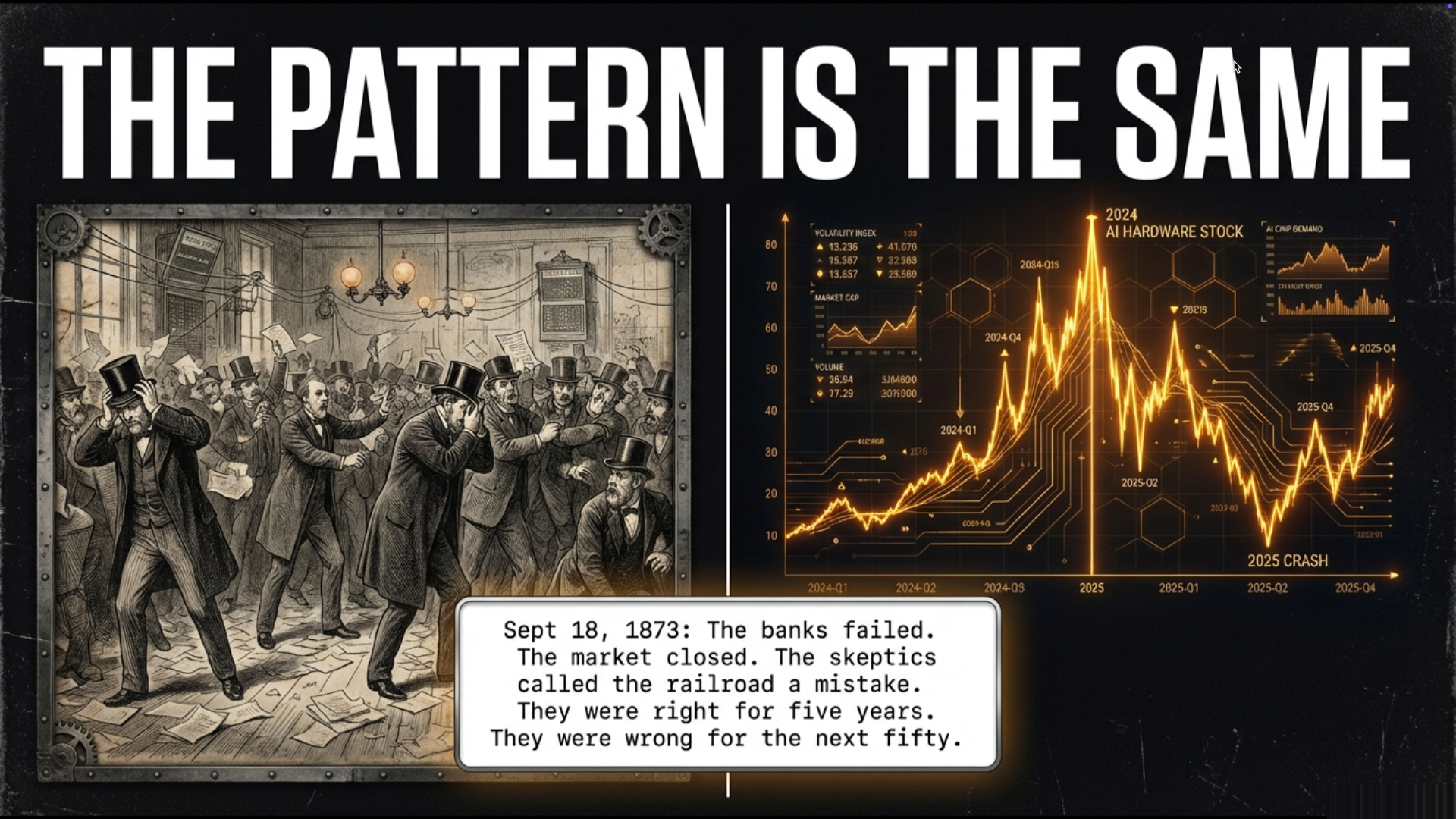
Each time, the criticism seemed reasonable for about five years. After that, they looked foolish for the next fifty.
Right now, we're in the middle of this cycle. Capital is pouring into AI infrastructure faster than it did during the dot-com boom. Skeptics are getting ready to criticize. In all this noise, a familiar pattern appears to be repeating.
This is that pattern.
My Thesis: Infrastructure Overhang
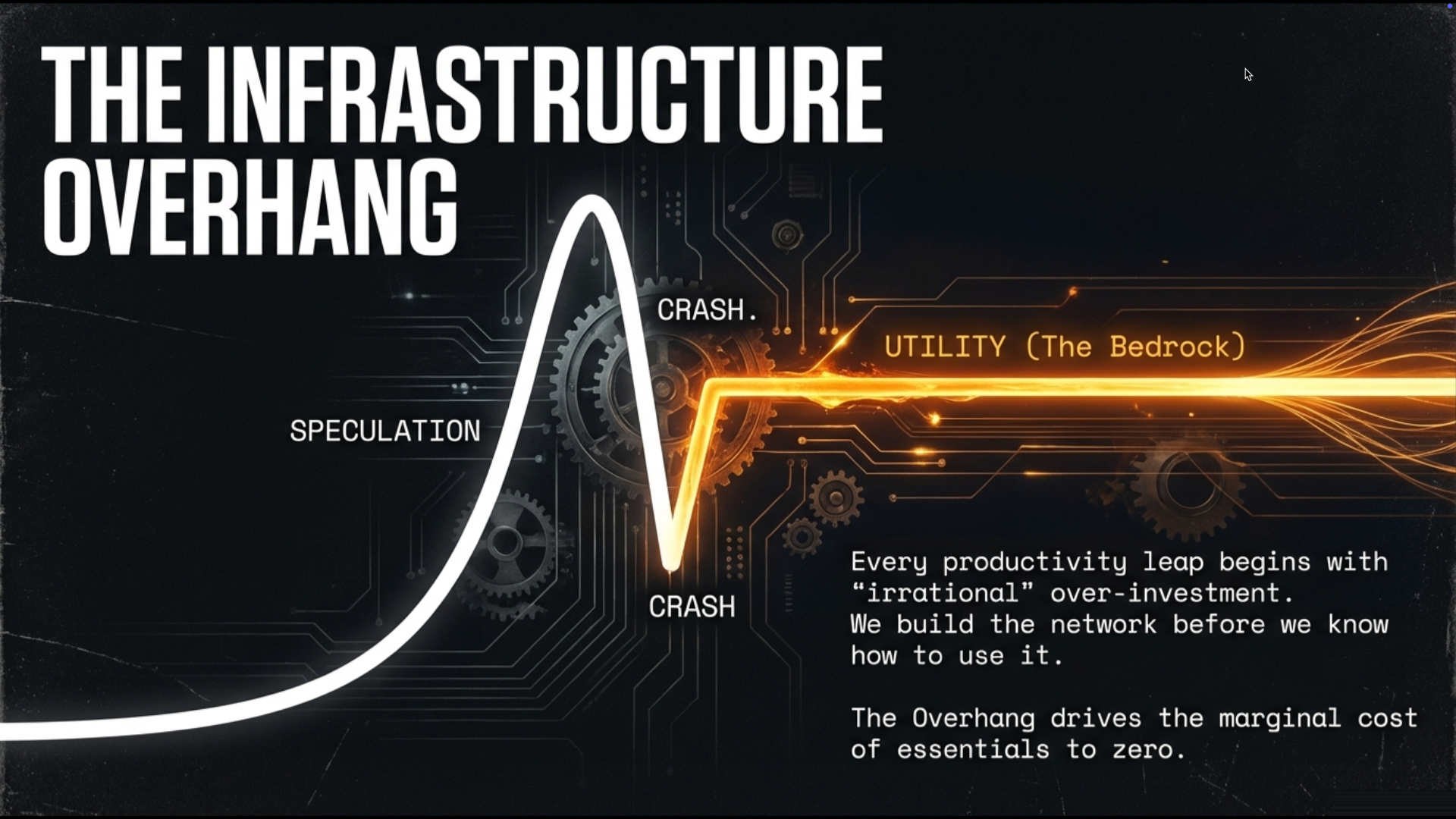
Here's the core idea. Every big jump in productivity starts with a period of what looks like "irrational" over-investment. We build huge networks before anyone knows how to use them. The market crashes. The infrastructure sits unused for a while. When demand finally arrives, the cost of doing business drops sharply.
I call this the Infrastructure Overhang.
The purpose of this overhang is simple: it drives down the marginal cost of something essential[1].
- The Railroad collapsed the cost of moving goods.
- The Power Grid collapsed the cost of energy.
- The Fiber Network collapsed the cost of information.
- AI infrastructure is collapsing the cost of cognition.
That last example might scare you, excite you, or maybe both.
Here's why this matters. Today's business models, like those in law, software, and consulting, are built for a world where human thinking is rare and costly. When "thinking" becomes as cheap as electricity, these pricing models don't just adjust—they break[1].
This pattern always wins. Infrastructure comes early, disrupts the old world, and then waits for the new world to catch up.
Part One: The Steel Nervous System
Chapter 1: Steel Before Settlement (September 1873)
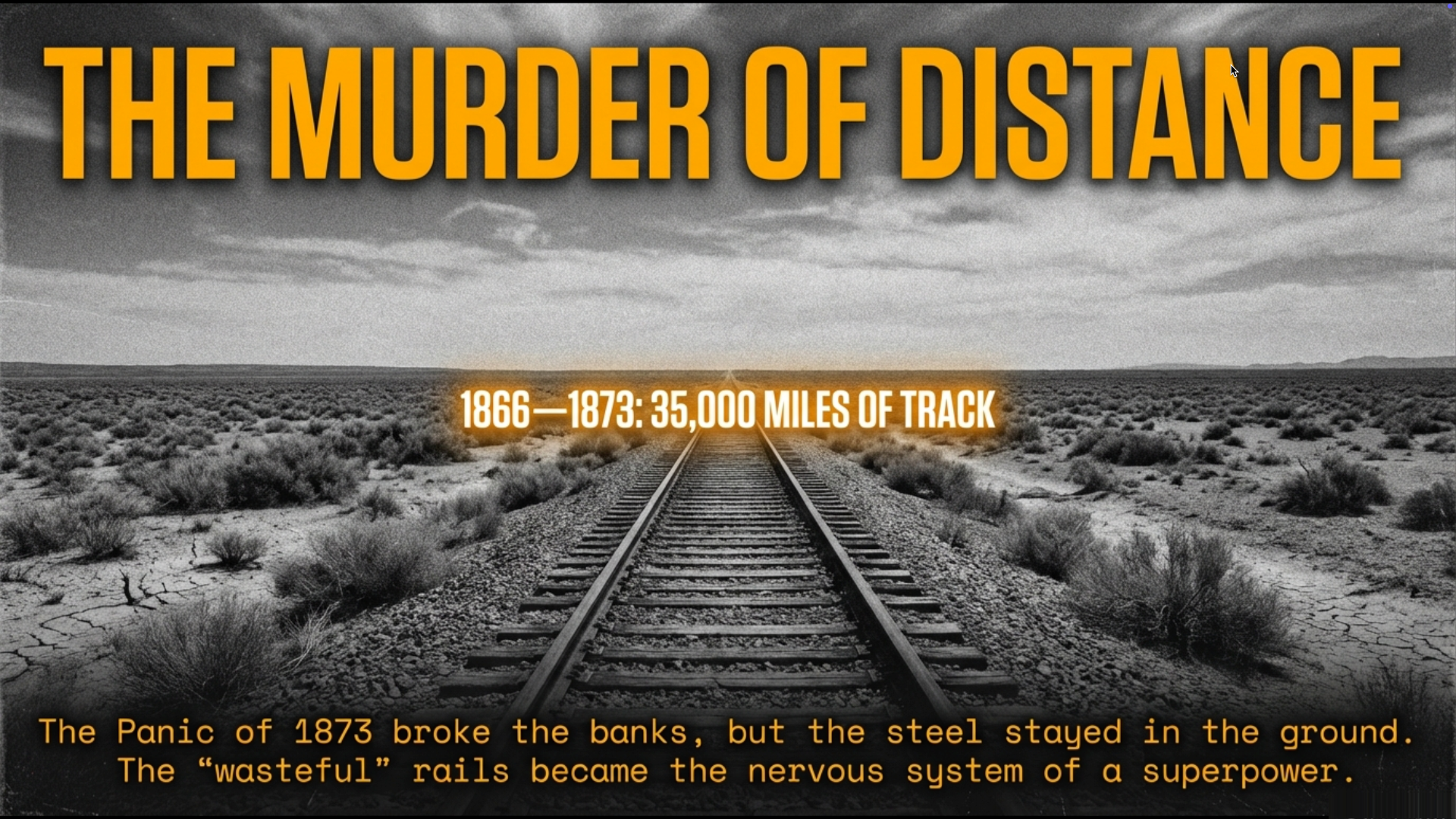
Between 1866 and 1873, Americans laid 35,000 miles of railroad track[2][3].
Consider that number: thirty-five thousand miles of steel laid into the ground, reaching places where hardly anyone lived. It was a huge bet on a future that hadn't arrived yet.
The skeptics in the 1870s weren't wrong. There wasn't enough freight or customers, and the credit supporting everything was shaky.
On September 18, 1873, that house collapsed. Jay Cooke & Company went bankrupt[2]. This was the bank that had financed the Union during the Civil War. The New York Stock Exchange closed for the first time for 10 days[2]. Eighteen thousand businesses went under in the depression that followed[3].
To the people living through it, the railroad was a catastrophic mistake. But here's what's important: the steel remained in the ground.
Banks collapsed. The tracks didn't. Over the next twenty years, those "useless" rails became the nervous system of a superpower. Refrigerated cars turned the Great Plains into the world's breadbasket. Chicago became a commercial powerhouse because every line ran through it.
The extra capacity from the 1870s, which broke the banks, was the main reason the growth of the 1890s was possible.
The infrastructure waited. The world caught up.
Chapter 2: The Harvest Gatekeepers (February 1887)
Once the railroads matured, a new problem emerged. Who captures the value?
During the 1870s and 80s, railroad companies became very powerful—so powerful that they controlled access. If you were a Midwest farmer, the railroad was your only way to get grain to market, and the companies took advantage of that.
Railroads charged small farmers high rates, while giving secret rebates to big companies like Standard Oil. The people producing the goods were being squeezed by those transporting them. We've seen this before.
The farmers organized. They called themselves The Grange[4]. They weren't fighting the technology. They were fighting for a fair share of the value they helped create. Their point was simple: once infrastructure is essential, it should be treated as a public utility. It shouldn't discriminate against the people who make it valuable.
This led to the Interstate Commerce Act of 1887—the first federal regulatory agency in U.S. history[4].
Now look at 2025. Writers, artists, and coders are the "farmers" of the AI era. Their work trained the models. They're watching the infrastructure providers capture all the value. The lawsuits against AI labs aren't just copyright disputes. They're the modern Grange Movement.
History may not repeat itself, but it often comes very close.
Part Two: The Geometry of Global Flow
Chapter 3: The Murder of Distance (August 1914)
The story of the Panama Canal is one of determination and loss. A French attempt in the 1880s had already buried 20,000 workers[5][6]. Yellow fever. Landslides. The jungle won that round. When the U.S. took over in 1904, they were stepping into a graveyard[5].
The American project took ten years and cost $375 million, which was about ten percent of the entire federal budget at the time[5][7]. All for a shortcut.
On August 15, 1914, they let the water in[5]. Two weeks later, World War I started. The expected flood of global trade was a trickle.
It looked like a very expensive hole in the ground. But here's what that canal accomplished: it shortened the trip from New York to the Pacific by 8,000 miles. It didn't wait for demand; it actually increased it.
The cost of distance dropped. Industries were born simply because shipping got cheaper. The infrastructure created its own economy.
It's the same pattern, just in a different century.
Chapter 4: The Box That Ate the World (April 1956)
If you want to understand AI infrastructure, study a metal box.
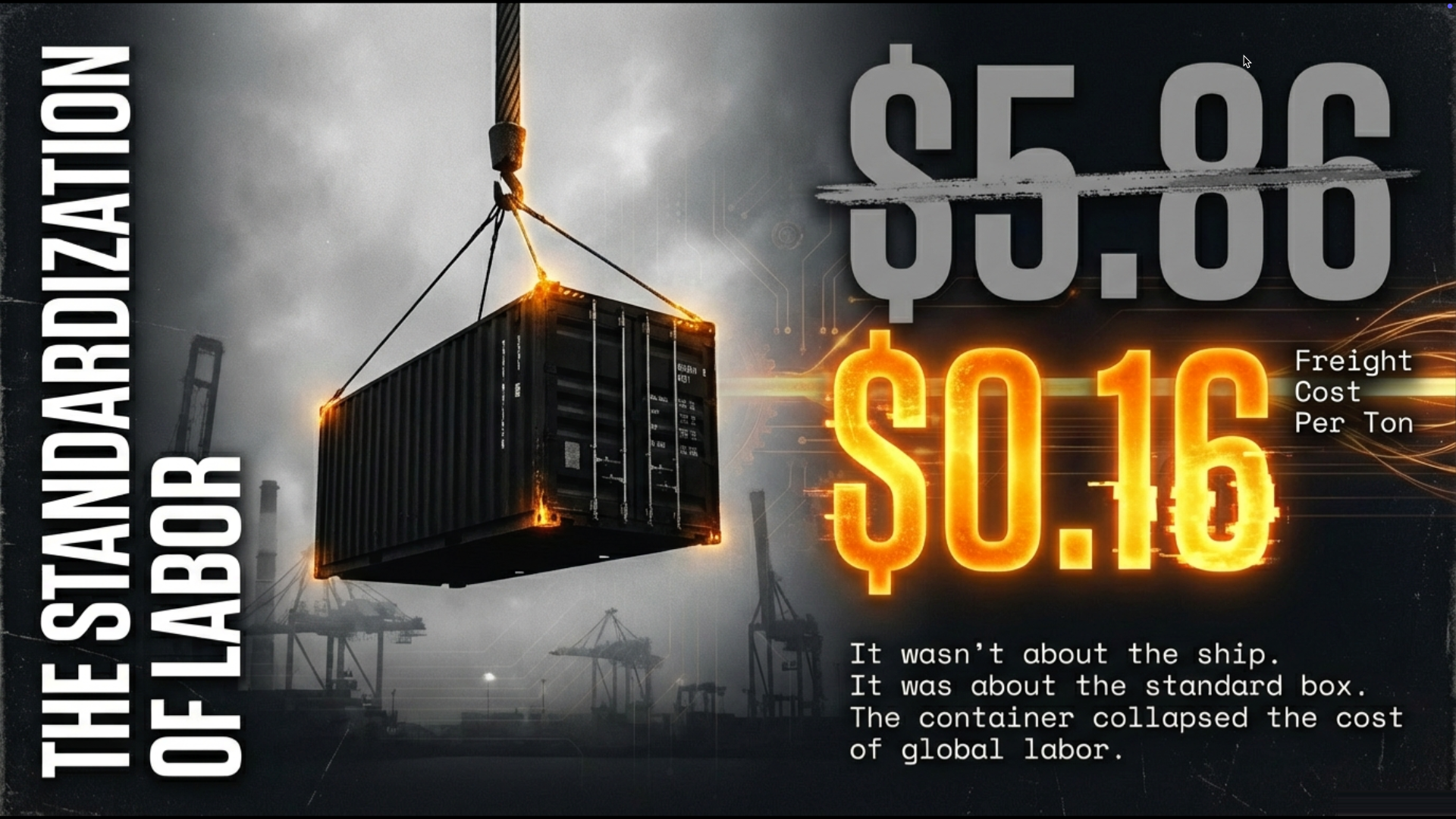
On April 26, 1956, a ship named the Ideal-X left Newark carrying 58 containers[8]. Before that, shipping was chaotic. Workers moved cargo by hand—sacks, barrels, and crates. It cost $5.86 in labor to move just one ton of cargo across a dock[8][9].
The container changed everything. Not because the box was special. Because it was standard. Every ship, every port, and every truck used the same box. That was the key. Standardization made everything work together.
The shipping industry resisted the change. Unions saw it as a threat to their jobs. Old shipping companies went bankrupt because they couldn't adapt.
But when the dust settled, the cost of moving freight dropped from $5.86 per ton to sixteen cents[8][9]. In case you missed it, read that again: from $5.86 to $0.16.
Overnight, the value of global labor changed. The modern supply chain began, all thanks to a standardized metal box.
Part Three: The Buried Light
Chapter 5: The Glass in the Ground (October 2001)
I witnessed this firsthand. The late 90s were wild. The Internet was new, and online business was just starting to take off.
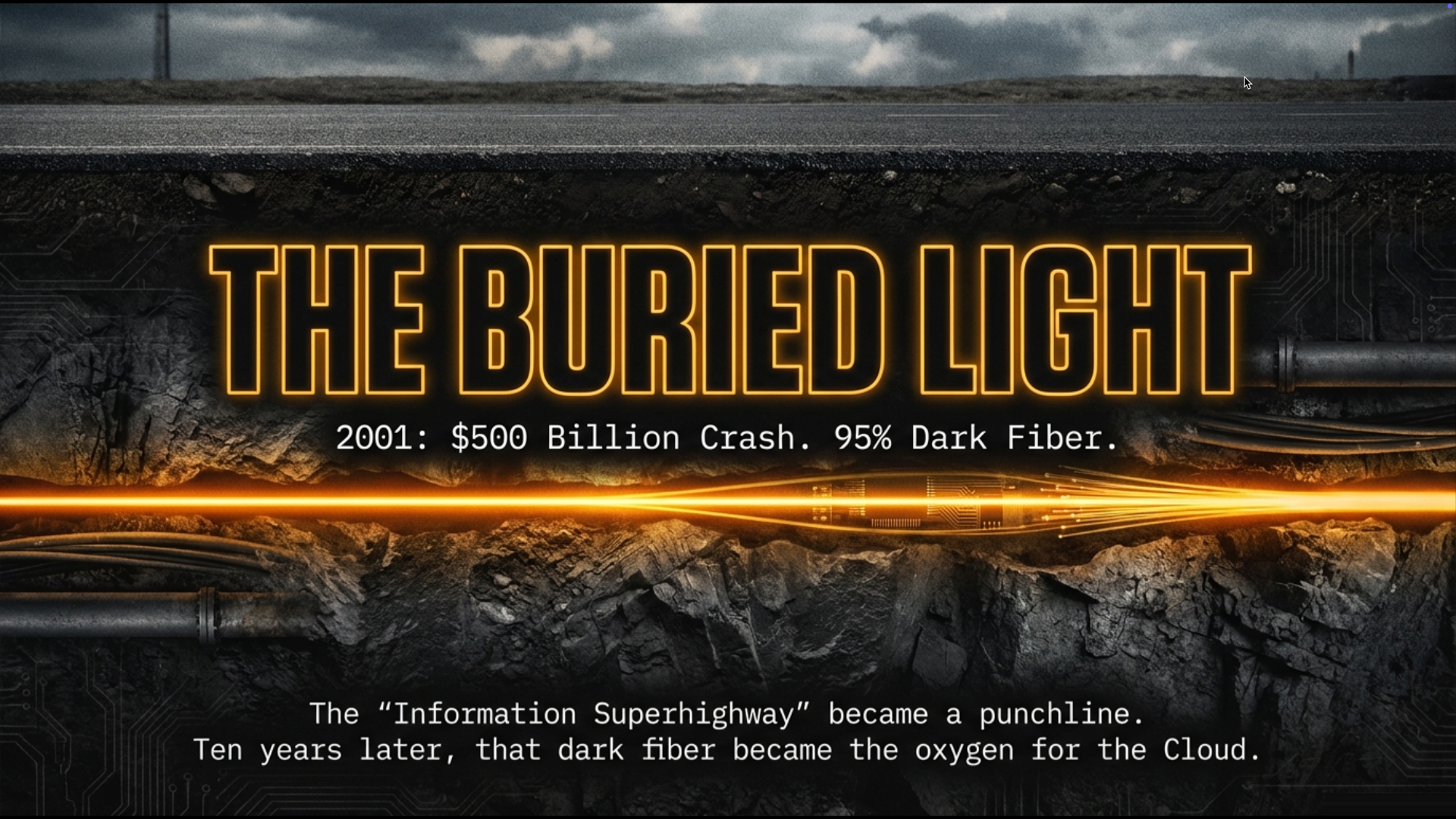
Telecom companies spent $500 billion burying fiber-optic cable[10][11]. Tens of millions of miles of glass were buried underground in a frantic bet on the Internet. I even wrote an article back then describing what the future of the Internet might look like. Most people weren’t convinced. They believed it was overhyped, and far too complicated. "It won't catch on..." they said.
When the bubble burst in 2001, the carnage was spectacular. Only about five percent of that fiber was actually being used[10][11]. WorldCom collapsed. Global Crossing went under[10]. The "Information Superhighway" became a punchline.
I remember the opinions at the time: "The internet was a fad." "We overbuilt by a factor of twenty." "All that fiber is worthless."
What actually happened: the glass stayed in the ground. For almost a decade, it sat there. Dark. "Wasteful." Then streaming video appeared, followed by cloud computing, and then a billion people joined social media. Suddenly, all that "excess" capacity was needed.
The infrastructure from 2001 became the oxygen of 2010. The investment itself wasn't a mistake. The timing was off. The world just wasn't ready to move that quickly.
Part Four: The Scaling of Cognition
Chapter 6: The Cathedral of Compute (Present Day)
We're back in the same old cycle once again. AI infrastructure is today's version of railroads, canals, and fiber. Billions of dollars are being invested. Skeptics point to empty data centers. But this time, we're not scaling goods, energy, or information. We're scaling cognition.
The numbers are staggering. In November 2023, Nvidia reported Data Center revenue of $14.51 billion[12]. By January 2025, that quarterly figure hit $35.6 billion[12]. That's a 145% increase in fourteen months.
Projections for 2026 suggest that collective capital expenditure by major tech companies will exceed $650 billion[13]. Alphabet (GOOGL), Amazon (AMZN), Meta (META), Microsoft (MSFT)—they're in a total arms race.
We're creating computing power before we even know how we'll use it. Sound familiar?
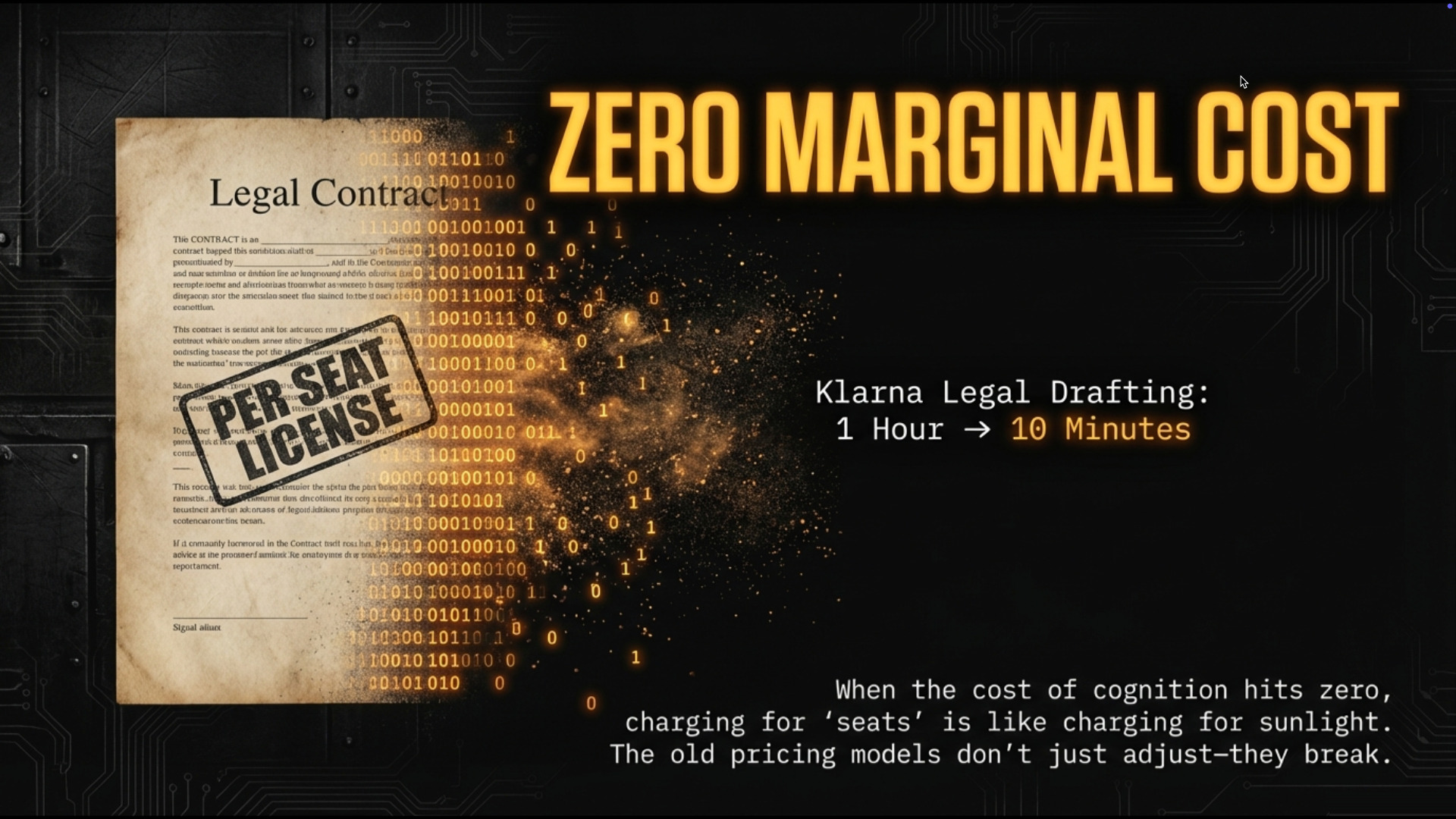
The shift in pricing has already started. Old business models are breaking down. Software companies used to charge by the "seat," or per user. But when AI can do the work, that measure no longer makes sense.
In May 2024, Klarna announced its legal team was using ChatGPT to draft contracts[14]. A one-hour task became ten minutes. Multiply that across every knowledge worker in the world. The math is brutal.
And clients are noticing. If AI reduces a four-hour task to thirty minutes, why should they pay for four hours? Some companies have already begun questioning legal and consulting invoices, arguing that AI-assisted work should mean AI-adjusted pricing. The message is simple: if your internal costs fall and your output accelerates, your fees will eventually follow. If you won’t lower them, someone else will.
When the cost of "thinking" drops toward zero, business models built on scarce human brainpower don’t slowly erode — they compress. And compression changes everything[1].
Chapter 7: The Modern Grange
The fight over AI training data feels uncomfortably familiar.
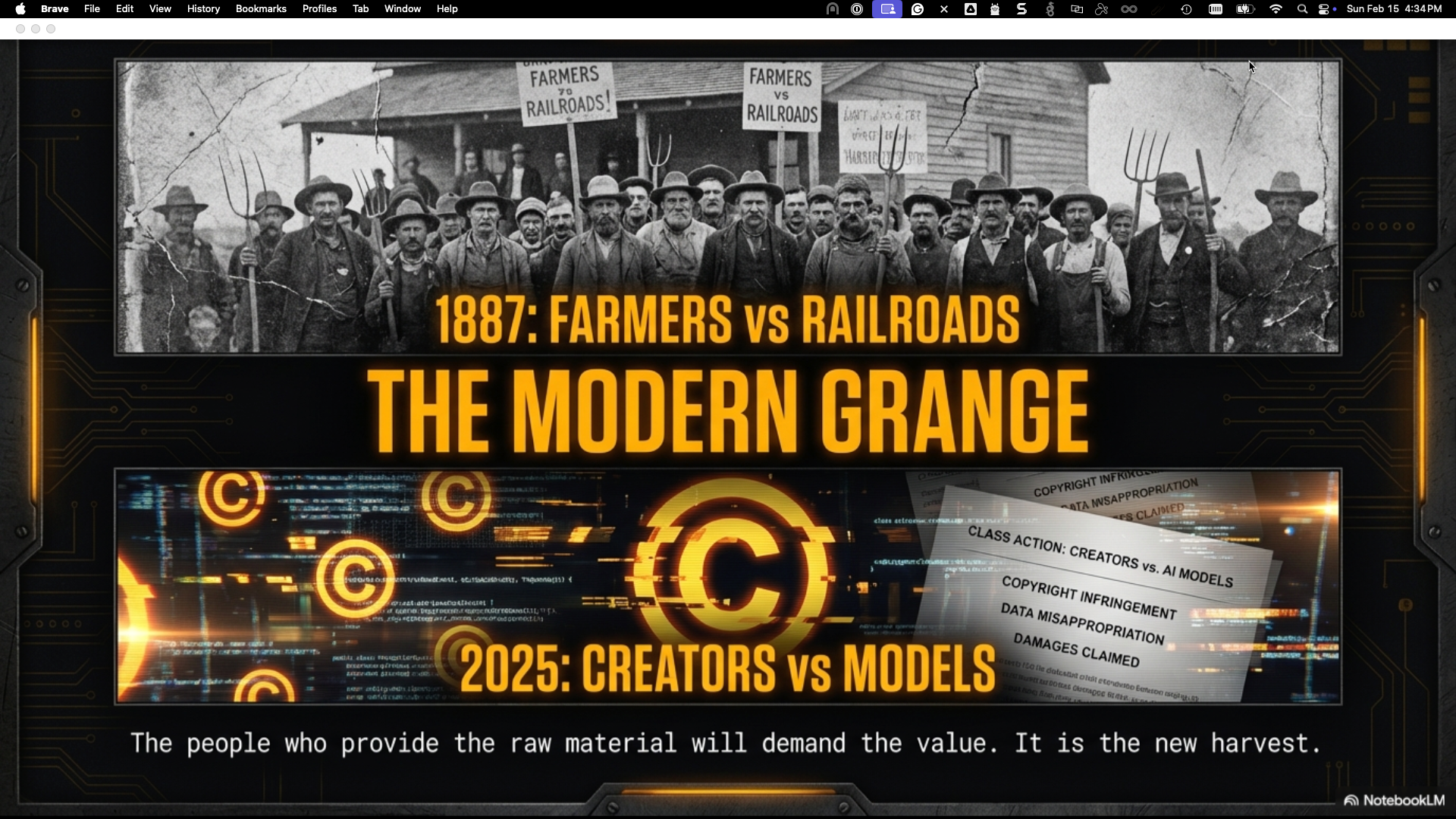
In the 1880s, farmers realized the railroads had become gatekeepers. They grew the grain. The railroads controlled the market. So they organized. The Grange didn’t try to destroy the railroad. They demanded a more equal share.
Today, writers, coders, artists, and creators are asking a similar question. Their work trained the models. Their archives filled the datasets. Now the infrastructure owners are capturing most of the value. The lawsuits aren’t just about copyright. They’re about ownership of "the harvest." But here’s where history stops being neat.
I don’t know how this will resolve. In 1887, regulation followed because railroads were tangible, geographic, politically visible. AI is diffuse. It’s global. It lives inside private data centers. The leverage looks different this time. The labs will survive. The compute will keep scaling. That seems certain.
What’s uncertain is whether creators gain bargaining power, new compensation models, collective licensing structures — or whether the value simply consolidates at the infrastructure layer.
Every infrastructure era produces conflict over who captures the surplus. That part of the pattern is predictable. The outcome this time is far more uncertain.
Epilogue: When Thinking Becomes a Utility
So what happens next? The infrastructure overhang is real. The computer is being built. The marginal cost of cognition is collapsing[1]. None of that is going to reverse.
Here's what I expect:
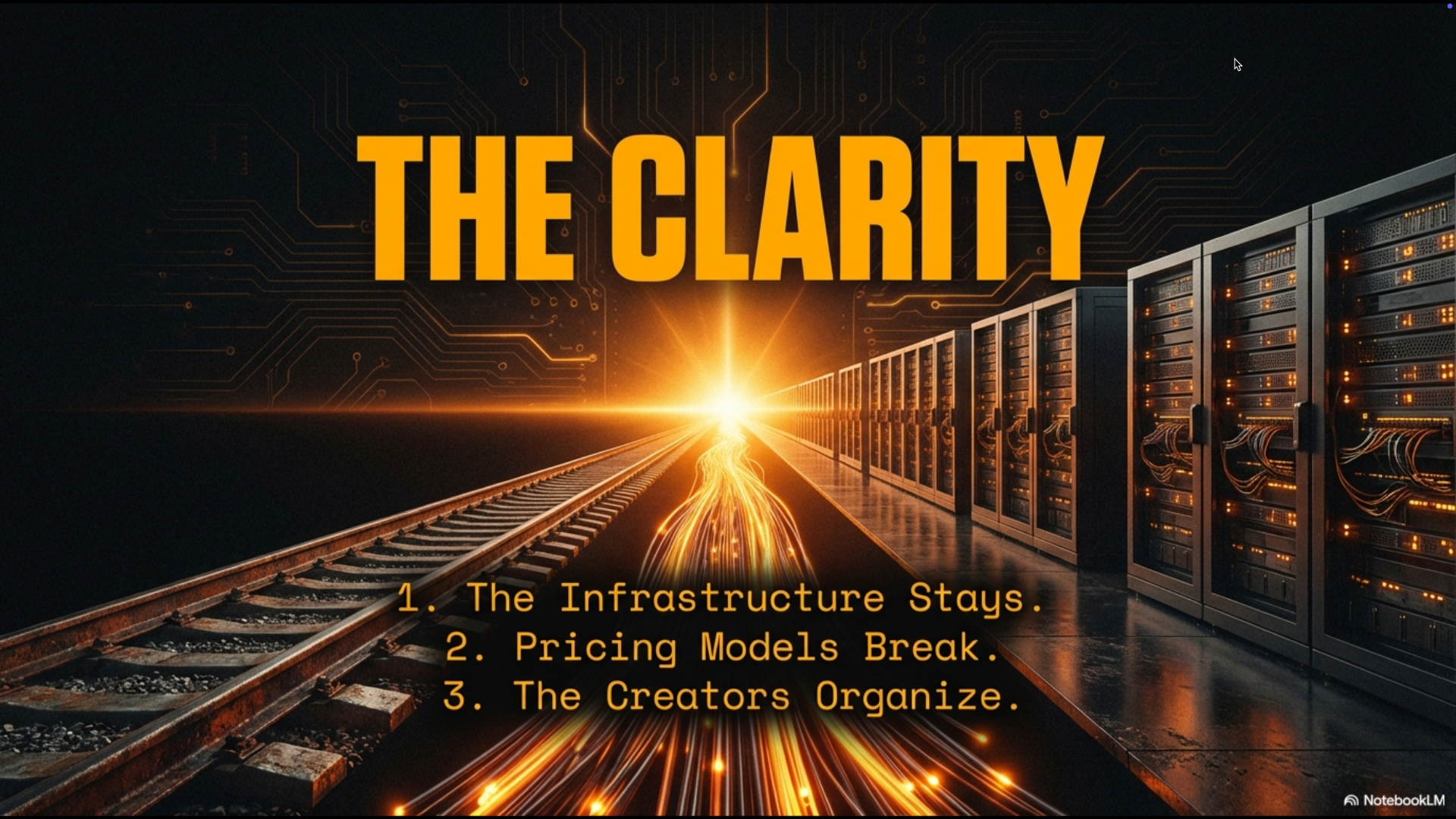
- The data centers will stay lit. Every infrastructure boom survives its panic. The rails stayed in the ground. The fiber stayed buried. The computer will stay on.
- Old pricing models will collapse. If your business charges for human time and AI can do the same work, that model is finished—not just struggling, but finished. The shift in pricing will be harsh for some industries.
- The creators will organize. Just like the Grange. Just like the dockers who fought containerization. The people whose work trained the models will demand their share. Some will get it. Most won't.
- New businesses will appear, as they always do. The railroad didn't just move goods; it created industries that couldn't have existed before. AI will do the same. The winners won't be those who see AI only as a way to save money, but those who see it as a brand new opportunity.
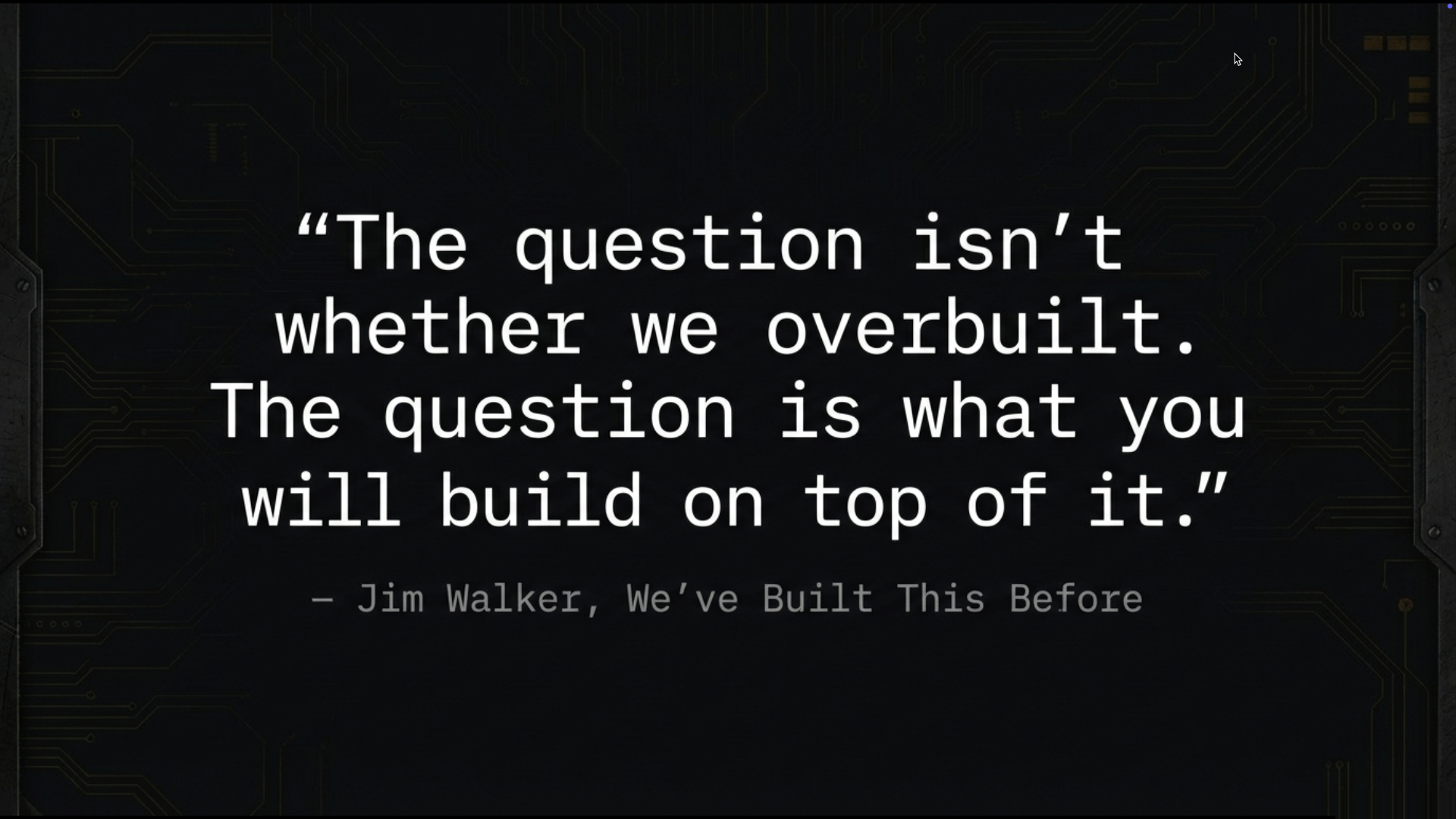
The question isn't whether AI infrastructure is "worth it." That's the wrong question. The infrastructure is being built regardless. The question is what you're going to do with it.
I've seen this pattern three times. In the middle, it always seems like chaos. Looking back, it always seems obvious.
We're in the middle.
We've seen this pattern before. We're watching it again. And when the dust settles, we'll wonder why we ever doubted it would work.
And then, the clarity. Again.
Frequently Asked Questions
What is Infrastructure Overhang?
Infrastructure Overhang is a period of massive investment in new technology networks (like railroads, fiber optics, or AI data centers) that creates huge excess capacity before the world knows how to use it. This overhang eventually drives down the marginal cost of something essential, like transport, information, or cognition.
How does AI infrastructure compare to the 19th-century railroad boom?
Both follow a cycle of rapid capital investment, skepticism of a "bubble," and a market correction. However, the physical infrastructure (the steel tracks or the GPU clusters) remains in place, eventually becoming the essential foundation for the next several decades of economic productivity once the world catches up.
What is the "Marginal Cost of Cognition"?
It is the cost of producing an additional unit of "thinking" or information processing. Just as the power grid made electricity cheap and fiber optics made data transfer nearly free, AI data centers are scaling compute to a point where "thinking" becomes a low-cost utility rather than an expensive human-exclusive resource.
Jim Walker has spent over two decades in technology, watching infrastructure booms come and go. He writes at internetter.com.
References
Books
[1] Rifkin, Jeremy. The Zero Marginal Cost Society: The Internet of Things, the Collaborative Commons, and the Eclipse of Capitalism. New York: Palgrave Macmillan, 2014.
[2] Chernow, Ron. The House of Morgan: An American Banking Dynasty and the Rise of Modern Finance. New York: Grove Press, 1990.
[5] McCullough, David. The Path Between the Seas: The Creation of the Panama Canal, 1870–1914. New York: Simon & Schuster, 1977.
[8] Levinson, Marc. The Box: How the Shipping Container Made the World Smaller and the World Economy Bigger. Princeton: Princeton University Press, 2006.
Government Documents and Archives
[4] National Archives. "Interstate Commerce Act (1887)." Milestone Documents. https://www.archives.gov/milestone-documents/interstate-commerce-act (accessed February 15, 2026).
[7] U.S. Department of the Treasury. Historical Federal Budget Outlays, 1901–1920. Washington, D.C.: Government Printing Office, 1921.
[11] Federal Communications Commission. Fiber Deployment Update: Status of Broadband Infrastructure Investment. Washington, D.C., 2002.
Corporate and Financial Reports
[12] NVIDIA Corporation. "NVIDIA Announces Financial Results for Fourth Quarter and Fiscal 2025." Press Release, February 26, 2025.
[14] Klarna International. "90% of Klarna Staff Are Using AI Daily—Game Changer for Productivity." Press Release, May 22, 2024.
[13] Goldman Sachs Global Investment Research. AI Infrastructure: The $650 Billion Buildout—2026 Capital Expenditure Projections. New York: Goldman Sachs, January 2026.
Periodicals and News Sources
[10] Litan, Robert E. “The Telecommunications Crash: What To Do Now?” — Brookings Institution analysis of the $500 billion over-investment and telecom sector collapse. https://www.brookings.edu/articles/the-telecommunications-crash-what-to-do-now/.
[3] National Bureau of Economic Research. "The Panic of 1873 and the Long Depression." NBER Working Paper Series, 1998.
Academic and Reference Sources
[6] Sutter, Paul S. "The Panama Canal's Forgotten Casualties." The Conversation, August 15, 2018.
[9] Rodrigue, Jean-Paul. The Geography of Transport Systems. 5th ed. New York: Routledge, 2020.